
Read the Full Book
Peter Singh has written a detailed book about croquet's history. Rather than serialise it in the Newsletter, Peter has kindly provided a link to download the complete work.
Download the full book →This series of croquet articles are based on formative research and hypothesising. It challenges the orthodox interpretation that croquet has Irish and/or French origins. Instead, it emphasises the evidence of Spanish and Italian influence. It's acknowledged the article is limited because no books on croquet's history were read.
This is the first article, "Croquet — A Curious Pastime". Peter Singh (September 2023). All rights reserved.
Colonial Beginnings
In 1863, the Sydney Morning Herald republished a magazine article on the virtues of an English gentleman farmer. It included a gentrified ideation of the farmer's daughters and croquet. The article's quip about the fragrance of daughters and beanfields might be distracting but the mention of croquet is one of its earliest printed references in the colony of New South Wales. The article evokes a romanticised Victorian-era view of croqueting women.
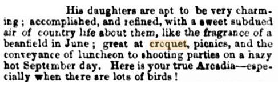
This mid-Nineteenth Century utopia typifies the sentiment that croquet was a somewhat esoteric pastime — perhaps evoking a sense of timelessness, indulgence, and virtue-signalling. By way of context, the seven Australasian colonies in the 1860s were witnessing a growing middle class, many of whom were keen to adopt fads from Europe and the United States. Noting the social 'atmosphere' in which croquet was played is relevant because it exposes some of the mythmaking on its origins.
Ostensibly, croquet was for physical recreation but, in reality, the game was more about conferring social status. In Europe, the wealth of the middle-class was spurred on by the Industrial Revolution and croquet was an opportunity for society's elite to 'escape' the negative consequences of the factory system and urbanisation...